
Medievalism and Pseudohistory
Course Number: ML303
Subject: Medieval Studies
Introduction 
This guide accompanies a workshop about research for your essay proposal.
Questions? Contact the Medieval Studies librarian, Meredith (mefischer@wlu.ca).
Check out Laurier Archives and Special Collections!
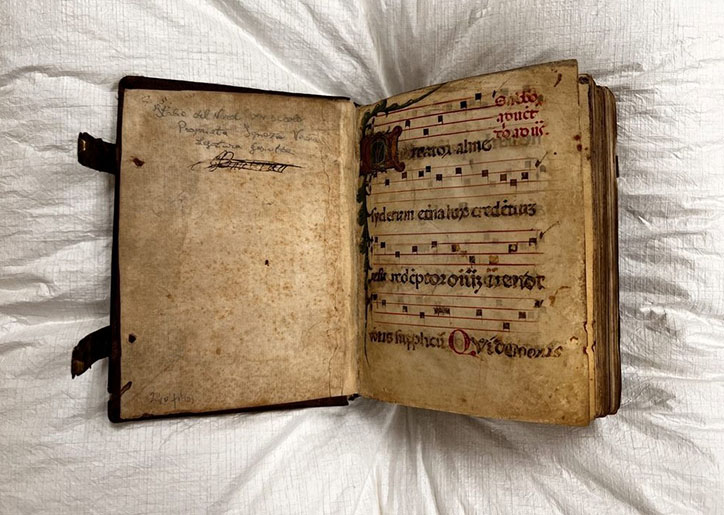
Description of Photo
This medieval hymnal with noted portions of the Mass was created in northern Italy around 1450-1475 for Franciscan use. The manuscript is resting on a book pillow and is open to the first folio. The first letter of the hymn is illuminated.

1. What Does Good Research Look Like?
From this week's required reading, "The Function of the Historian in Society" by Richard C. Carrier:
[T]rue historians will identify every primary source, every shred of relevant evidence, so the reader will be able to check their claims. Where the evidence is incomplete and they have to speculate, they will admit it, keeping facts and judgement distinct. They seek to understand why things happened the way they did, and will openly use evidence to support their accounts, and by concealing nothing, and by not pretending their assumptions are facts, they permit the reader to form his or her own judgement about the truth. Above all, they open themselves to the examination of their peers and facilitate future scholarship by checking and correcting the claims of other historians (522).

a) Habits of Mind for Good Research
Habits of mind facilitate good thinking and deepen understanding of the world. The six habits below are key for research. They can give you closer "cognitive contact with reality" (Zagzebski 298). That's what it's all about!
- Intellectual thoroughness - seeking in-depth understanding through comprehensive inquiry (e.g. digging for more sources).
- Intellectual courage - willing to pursue knowledge in spite of possible risk (e.g. fear of being wrong).
- Intellectual tenacity - persisting even when there's a challenge (e.g. working through anxious feelings).
- Intellectual humility - accurately assessing your own limitations (e.g. owning that your knowledge of a topic may be incomplete).
- Open-mindedness - considering alterative perspectives and adjusting beliefs accordingly (e.g. reading an article that doesn't support your original thesis).
- Curiosity - expressing a desire to find out more and going for it (e.g. asking good questions).
Your Turn!
Where do these habits show up in Carrier's description of good research? Based on the six habits, would you add anything to the description (what might be missing or edited from your perspective)?
b) Habits Take Practice
Good research takes practice, and habits of mind are part of that practice.
Challenges to Consider
- Environment
- Practicing habits of mind calls for a supportive and respectful environment.
- Consider how you might practice open-mindedness in a conversation with someone you trust, versus scrolling through a social media feed. In the former environment you would probably be more inclined to consider an unfamiliar point of view, in the latter environment it's a good idea to be cautious because of the ways problematic information spreads online.
- Pseudohistory "is presented as historical knowledge” (Leeson 313). It can be hard to detect intentionally false information that looks a lot like a legitimate source at first sight.
- Cognitive biases
- These "can distort the way we interpret information, leading to false perceptions of reality, and affecting our ability to reason" (University of Saskatchewan).
- Two examples are: (1) confirmation bias, the tendency to favour information that aligns with your existing beliefs, and (2) myside bias, the tendency to scrutinize opposing viewpoints more harshly than existing beliefs.
These challenges speak to the fact that good research is a social activity. We need to rely on one another for different areas of expertise and different ways of thinking.
Practical Skills
There are specific skills for each habit of mind. The following table gives examples. Try these out when you work on your essay proposal.
Habit of Mind | Description | Practical Skill |
|---|---|---|
Intellectual thoroughness | Seeking in-depth understanding through comprehensive inquiry. | Use a synthesis table to make connections between sources, try lateral reading, and learn to read like a peer reviewer. |
Intellectual courage | Willing to pursue knowledge in spite of possible risk. | Moving Beyond the 5 Paragraph Essay will help you take a chance by getting out of a familiar but restrictive structure. |
Intellectual tenacity | Persisting even when there's a challenge. | Use an an assignment planner to schedule time effectively and give yourself leeway to face challenges when they arise. |
Intellectual humility | Accurately assessing your own limitations. | Ask questions in class and seek assignment clarification. You can always ask your librarian for research help! |
Open-mindedness | Considering alterative perspectives and adjusting beliefs accordingly. | Practice citation counting: actually count how many women and people of colour are cited (see Citation Justice). |
Curiosity | Expressing a desire to find out more and going for it. | Ask open-ended questions. See Developing a Research Question and try using the accompanying worksheet. |
2. Searching for Articles and Books
a) Selecting Search Tools
The Library search tool, Omni, is a good place to search for books.
Databases are the best places to search for peer-reviewed journal articles.
b) Using Search Tactics
The following brief tutorials about search tactics will help you save time and improve the relevancy of your results.
Video - Searching Systematically
Video - Better Searching Using Truncation