
Doctoral Residency Week
Course Number: SK820
Subject: Social Work
Table of Contents
1. Literature Review 2. Searching 3. Literature Review Tools 4. Synthesis Matrix 5. Worksheet
Introduction
This guide accompanies an in-class workshop about literature review.
OBJECTIVE: draft a working plan for reviewing the literature.

1. Literature Review
THE PRODUCT: A literature review is a survey of research about a particular topic.
- It's specific - focuses on a research question.
- It's selective - includes a curated selection of research.
- It's a synthesis - brings together discussions from across the research.
- It's a starting point - identifies where your research fits into the picture.
- It shows accountability - demonstrates how you're tuning-in to others' work and voices responsibly.
THE PROCESS: There are different ways to review literature. Your methods need to fit your goals for the project at hand.
- Where types of literature are you looking for?
- What keywords will get you good results?
- What search tactics will help you identify relevant studies?
The rest of this guide covers THE PROCESS to help you move toward your literature review goals. There's a lot of literature out there … and in different places! Some research is published through formal channels (journals), some is unpublished (conference papers, theses), some is in alternative formats (podcasts), some is ephemeral (conversations, seminars), some is indexed in structured databases, some is discoverable through search engines, some is behind paywalls.
Figure 1
Three Goals for Reviewing the Literature
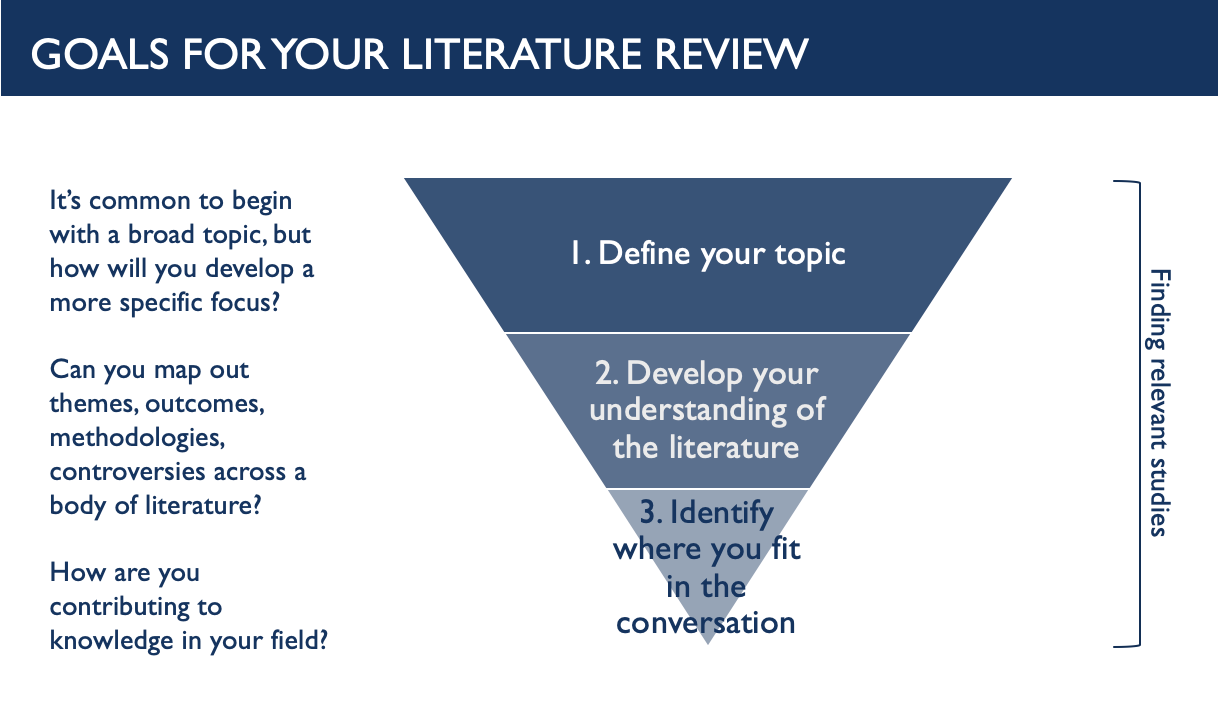
Image description
Goals for your literature review. 1. Define your topic. It’s common to begin with a broad topic, but how will you develop a more specific focus? 2. Develop your understanding of the literature. Can you map out themes, outcomes, methodologies, controversies across a body of literature? 3. Identify where you fit in the conversation. How are you contributing to knowledge in your field? Throughout all 3 stages, you'll be finding relevant studies.

2. Searching
a. Article Databases
There is a list of databases relevant to Social Work. Choose databases to search for your topic based on the descriptions.
- Limit results to peer-reviewed.
- Discover key articles.
- Recognize key scholars.
- Avoid missing important results.
- Cut out irrelevant results.
b. Keywords
What are the major concepts in your topic? What are some synonyms or alternate terms you can use?
- Consider the terms typically used in research literature.
- Google "synonyms for ..."
- If you have an on-topic article ("seed article"), see what terms get used in the title/abstract.
Major Concept | Keywords |
|---|---|
Teenagers | Teens, adolescents, adolescence, youth |
c. Field Searching
- Use the drop-down beside a search box to find terms in specific areas of results. Codes beside each field tell the database where to search for a term.
Example: ti("adverse childhood experiences") in PsycINFO (all results will have the term in titles).
d. Limits
- You can limit results to peer-reviewed or scholarly.
- A date limit is also sometimes useful.
e. Search Tactics
Try using some of the following database search tactics to get better results.
What is the tactic? | What does the tactic do? | Examples |
|---|---|---|
Boolean AND | Use AND to ensure that all terms appear in every search result. | depression AND home care |
Boolean OR | Use OR to ensure that at least one term appears in every search result. | transgender OR LGBTQ OR GLBT |
Phrase searching | Use “quotation marks” to find more than one term in a row. | “brain cancer” |
Truncation | Use an asterisk* at the end of a term to include multiple endings. | trauma* trauma, traumatic, traumatically, traumatize, traumatized, traumatizing |
Wildcard | Use a question mark ? within a term to search for variations of a single character. | decoloni?e decolonize, decolonise |
f. Subject Headings
- These are controlled terms from a database thesaurus that are assigned to articles.
- Different databases have different thesauri, which affects the subjects you use.
- Note: you'll usually see a link to the "Subject Headings" or thesaurus in a database's menu.
Major Concept | Keywords | CINAHL Subject |
|---|---|---|
Teenager | youth, adolescents, adolescence, teenagers, teens, young people, young person | ??? |
3. Literature Review Tools
a) Citation Management Software
- Zotero is a free citation management tool.
- Manage all sources in one place.
- Create folders and subfolders for projects.
- Store, read, annotate PDFs.
- Save screenshots from websites.
- Access sources from any browser.
- Create group libraries.
- Create and update in-text citations and references automatically.
b) Citation Mapping
Citation mapping is a way of tracking conversations across the literature. Try Citation Tree is one example. Tools like this can help you visualize citation relationships between articles.
Figure 2
"The Use of Adventure Therapy in Community-Based Mental Health" Citation Map
Image description
A citation map showing the relationship between articles that cite and are cited by a paper called "The Use of Adventure Therapy in Community-Based Mental Health." The earliest article in the image is from 2009 ("The Effect of Acute Treadmill Walking on Cognitive Control and Academic Achievement in Preadolescent Children"), and the most recent is from 2018 ("Of Dodo Birds and Common Factors: A Scoping Review of Direct Comparison Trials in Adventure Therapy").
c) AI Tools for Literature Review
There are specific Generative AI (GenAI) tools intended to facilitate different parts of literature review, such as:
- Brainstorming topics
- Refining research questions
- Finding connected sources
- Summarizing information
You’ll find examples of AI tools for these activities in this guide: Emerging AI Tools for Literature Review (Hong Kong University of Science & Technology).
There are several important reasons why you should avoid relying on the well-known free tools as a primary or sole source for academic research.
- Limited language model
- GenAI queries a large language model made up of public, freely available data (web pages, Wikipedia, etc.), and does not include much academic or peer-reviewed content. As of August 2025, Reddit and Wikipedia now dominate ChatGPT citations.
- Lack of source transparency
- GenAI doesn’t cite sources unless explicitly asked, and even then, it can generate fake or inaccurate citations. This makes it unsuitable for producing verifiable, citable academic content.
- Potential for inaccuracy
- While GenAI is generally reliable, it can produce confident-sounding but incorrect or misleading information, especially in niche or rapidly evolving fields.
- Lack of critical analysis
- GenAI summarizes well but does not engage in deep, critical thinking or original analysis, which is essential for high-quality academic work.
You should acknowledge AI if you use it for your literature review process. There are acknowledgement templates in Laurier’s Generative AI Guidelines.
4. Synthesis Matrix
Adapt a synthesis matrix like the one linked below to compare studies across the literature.
- Synthesis matrix template (Google Doc).